Sunday, July 3, 2011

Day 37 Mykonos, Greece

Day 37 Mykonos

Blue sky, blue sea and white buildings….

Phew; am I glad we had a sea day yesterday. After the hectic days in Egypt and Israel we needed to recharge our batteries. We had a formal night last night, again, and virtually straight after dinner we headed off to our cabin. The decks after dinner have been fairly quiet at the moment; I hear you can even get a seat in the lounges for the floor shows. I have been too exhausted to update my blog straight after a shore tour, I apologise. I expect the 5 day run of ports in Italy and Spain will be the same.

In comparison to the previous ports, we were taken ashore by the ships' tenders. The tender service took us right to the pier in the town. Paul and I went ashore early when most of the shops were still closed, however this allowed us to meander the narrow cobbled alleys of this idyllic place with few people about. We walked past tiny squares lined with planter boxes planted with geraniums and walls topped by bougainvillea producing splashes of colour on a backdrop of white.

The granite island had been ruled by Venetians until the early 18 century, later it became a haven for pirates in the area. We could see many little chapels as we walked through this tiny town. Sailors and pirates in times of stormy weather vowed to God to erect a chapel if they returned safely home, so I assume there must have been a lot of hairy sea days!

We had a gentle walk up the hill to see the windmills which had originally been used to refine grain. Then as we made our way back towards the centre of the town, we stopped off to enjoy a coffee in one of the outdoor restaurants overlooking the sea. By the time we wandered into the shopping area, the shops had opened and we were able to pick up some postcards and look inside some quaint little shops. Just before arriving back at the pier, we passed another little chapel, packed with men who were singing a hymn. I didn't see any ladies in this tiny chapel only about a dozen men….I did say the chapel was tiny!

By the way, I noticed a lot of the Greek men were speaking English with an Aussie accent! Tonight we stayed up late to catch a live act of Amy Abler, a piano 'divalicious' who played at the Adelaide Fringe this year.  Great performance.

Day 35 Ashdod and Jerusalem

Day 35 Ashdod, Jerusalem and Dead Sea

Emotional, overwhelming, powerful, jaw dropping….

Wow what an incredible day.

It wasn't the best starts for the day I have experienced but well worth the lack of sleep and general early morning grumps from me. The ship travelled into another time zone overnight and instead of gaining another hour, we lost one. The hectic day in Cairo, the short night and the early morning start gave me good excuses to feel out of sorts. I think everyone in the group felt the same way, so the first hour on the bus our guide did all the talking.

We passed many crops as we travelled into Jerusalem, the modern farming techniques a sharp contrast to yesterdays. I couldn't help but be amazed at the difference of the two countries which are separated not only by a short distance but by culture and infrastructure.

Our trip into Jerusalem took the scenic route, until we drove to the Palestine check point with its high metal fence, topped off with razor wire. We come from a country surrounded by sea with our nearest neighbour several hundred kilometres away, I find the division hard to digest and can only hope one day differences are settled.

We entered the Old City of Jerusalem via the Jaffa Gate and explored the narrow alley ways. It is home to the cornerstones of three faiths: Christianity, Judaism and Islam. As our guide walked us through the sections of the Christian Quarter, I had been busy taking photos, completely staggered that these alleyways are the same as they were over 2,000 years ago. There were little shops selling souvenirs, religious items, spices and clothing. The group had stopped at a small square and our guide had just finished talking about a building in front of us, as I and a few others had come up from the rear and had missed out on what had been said. Anyway, we all walked directly into a church which was crowded with various groups, immediately turned right and climbed a very steep staircase to the first floor. When we reached the top, I asked Paul what were we looking at…….my heart missed a beat and the impact of what I was actually looking at completely floored me. We were in the Church of the Holy Sepulchre and I was looking at the site where Jesus had been crucified!

We walked down the stairs and saw the area where Jesus had been anointed and the Tomb of Christ itself. This, I was not prepared for and I am now still emotional about where I have been and what I have seen.  I actually went into the Tomb of Christ. Oh my goodness. Mel and Bill, I wish you were there with us; you were both, very much, in my thoughts at that time.

We then head off weaving our way through the Jewish Quarter, taking in the various sites until we gathered at a large open square where we see the Western (Wailing) Wall, the most holy Jewish site in the world. People were praying at the Wall. It is the only remaining piece of the great Temple; built to hold the Ark of the Covenant. In the cracks of the wall we could see pieces of paper which had written prayers. What another overwhelming experience.

We made our way out of the old city via Herod's Gate, walking through the Moslem Quarter. Our guide then pointed out we were travelling along the Via Dolorosa, the path that traditionally traces the last steps of Jesus Christ. There are 14 Stations of the Cross which are connected to a particular event. The 1st station is where Jesus was condemned to death; the last is the Holy Sepulchre. Pinch.

Once out of the old city we walked past the Mount of Olives to the Garden of Gethsemane where Jesus was praying when he was arrested. We saw over 2,000 year old olive trees there. We saw the Church of All Nations next to the garden before boarding our bus to drive to the Dead Sea.

We were in a different mood when got to the Dead Sea. The temperature in the afternoon had risen, however it was not hot. Actually, since Dubai we have not experienced stinking hot days, warm but not hot, which has been a plus since we have been in areas which would have been unbearable if it had been over 34C. Paul decided he did not want to 'float' in the Dead Sea, so I joined the rest of our group in the water. Our guide suggested not to let the water in our mouths and not to splash the water onto our faces as it was very salty and very unpleasant. Yeah, was she right! I accidently splashed some on my face and I reckon a droplet got onto my lips and near my left eye……….well it was the worst taste I have ever experienced and my eye stung like anything. I wasn't game to wipe my eyes as my hands were wet. I just squinted my left eye till I managed to get out of the water, walk up the hill and rinse it under water. I rinsed my mouth several times but it took several hours and copious drinks of water to get rid of the taste. Getting out of the water was a mean feat to manage. I had trouble getting to stand in the water, then, when I did, the mud underfoot was very slimy and uneven. But apparently I am told the mineral-laden waters are supposed to be very healing! I survived the Dead Sea!

Saturday, July 2, 2011

Day 34 Port Said and Cairo

Day 34 Port Said and Cairo

Our day in Egypt started early, we had to be ready and on board the bus by 7am. Fifty Four buses travelled to Cairo, under armed escort. Police had blocked off connecting and cross roads to allow the convoy to travel uninterrupted. Armed soldiers with AK47's travelled in canopied utes which had the sides cut out to allow the barrels of the guns to fire unheeded, led and followed the convoy with a few spaced in between the buses. Each bus had an armed guard on board. Our armed guard wore a dark suit, dark sunglasses and had a pistol in a holster under his suit jacket. He stayed with us the whole duration of our tour, even when we left the bus. Eeek.

There were 22 of us private tour passengers who had the use of a 44 seater bus. It enabled us to spread out and have 2 seats to ourselves. The bus had a toilet on board which is a necessity for the 3 hour each way trip.

After leaving Port Said the road followed alongside the Suez Canal for around 30 kms before heading west towards Cairo. We saw what looked like huge tankers sailing on the sand dunes but were actually sailing on the canal just behind the dunes. We passed many farms, the farm houses square, usually single story buildings with the roofs laden with grasses. The guide explained this vegetation formed a type of insulation, no pink batts here!  Many of the crops (mango, corn, rice, fruit and vegetables) were irrigated from the River Nile.

Our first stop in Cairo was the Egyptian Museum of Antiquities full of thousands of ancient artefacts and King Tut's $$$$$ solid Gold Mask and other treasures found in his tomb. Overlooking this museum is a huge modern office building which had been gutted by fire during the January revolution. Today it stands as it was left after the fire had been put out. When we drove passed the front of the building someone had noticed it was a Government Office for Women. Our guide praised the actions of the revolution and said that the people of Egypt will vote in 3 months' time. I am not sure when the 3 months are up, but I got the feeling no one is stepping up to offer an alternative to the military rule.

We were to glide down the longest river in the world, the Nile, on a felucca; however we were told there wasn't enough wind to sail the boat and we had a motorised alternative which got us to the riverside restaurant for lunch on time! We were offered a good selection of food for lunch including salads which Paul and I steered clear of. No Cairo belly for us! Quite a few of our group did indulge in the salads and had no after effects.

Next stop;  The Great Pyramids of Giza. Giza pronounced 'jeeza'. We were surprised to see residential properties built right to the perimeters of the pyramids.   The Grand Pyramid was our first; however we needed to run the gauntlet of harassing hawkers, cameleers and horse entrepreneurs, and general pesky peddlers before getting to the base of this awesome structure. Once we navigated our way around the hindrances we were both overwhelmed by this 4,500 year old structure. As I touched the base of this Seventh Wonder of the Ancient World, an image came to me, of the WW1 AIF soldiers' photo of them perched over these same blocks just before heading off to Gallipoli. Poor buggers, apparently a third never came back.

A panoramic view of the 3 pyramids before stopping at the Sphinx had our cameras working overtime. Annie you would have gone ballistic here. No, on second thoughts your camera would have burnt out long before Egypt! We weren't harassed here as much. Our security guard followed us everywhere, darting his head around corners, walking in front or bringing up the rear. Generally all over the place!

The last stop before leaving Cairo was a papyrus shop which also had the last 'throned' toilet amenities before the tiny, cramped but much appreciated bus toilet. We arrived back to the ship by about 8pm having spent an awesome and amazing day in Egypt. A thankyou to Ros and Arnold who organised this tour.


Friday, July 1, 2011

Day 33 Suez Canal

Day 33 Suez Canal

Over 1 ½ million people worked on digging this manmade canal from 1858 to 1869. From the time it opened, the Suez Canal had enhanced international shipping by reducing the sailing distance between Europe and the Far East. For example, travel from London to Mumbai saves more than 5,000 miles at sea.

We awoke early to witness the commencement of our transit through the southern entry point of the Suez. The sun glowed through the early morning mist as is rose over the desert and lit the scene. DP led the second northbound convoy. Most of the interesting sights were on the portside of the ship, whereas the starboard's vistas consisted mainly of sand, sentry towers and the occasional abandoned, rusty dredging pipes.

By around lunch time we approached the Suez War Memorial then further along the longest swing span bridge in the world, El Ferdan Railway Bridge. I positioned myself on a deck chair on the portside for most of the morning just watching the farms, small towns and many date trees slowly enter and leave our view. We were cruising at about 8 knots.

Poor Paul wasn't travelling too well. He spent most of the day in the cabin unable to walk. An angry red spot appeared on the top of his foot which had me worried but a trip to the doctor confirmed he had gout! A couple of tablets later he was back on track. All the rich food selected from our dinner menu has not helped.

By 4pm we had approached Port Said, the end of our transit through the Suez.


Sunday, June 26, 2011

Day 31 Aqaba and Petra

Wadi Rum
Bedeoan Camp
Paul and Linda overlooking Aarons Tomb
Aarons Tomb Buggy
Adelaidians
 

Day 31 Petra part 2

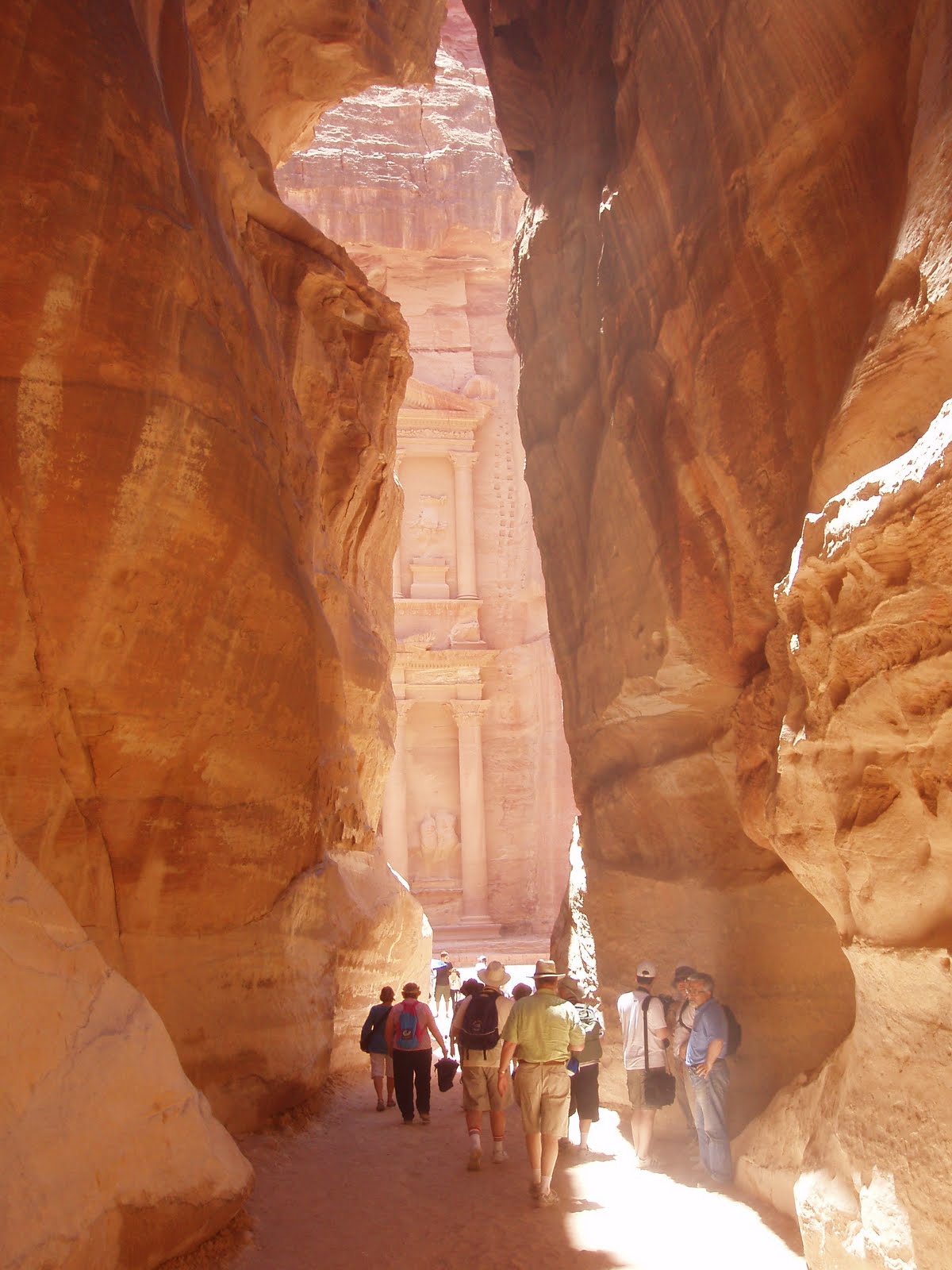
Wow first glimsp of Treasury
Tombs Petra
Theatre in Petra

Day 31 Aqaba and Petra, Jordon

Day 31 Aqaba and Petra

Oh My Goodness! Wow!  Magnificent! Impressive!

On our arrival back to the ship last night Paul and I kept looking at each other with these big smirks on our faces…….I kept thinking to myself 'pinch me, I must be dreaming'. My heart is still beating a fast tattoo just thinking about what we experienced yesterday. Please; anyone thinking about doing this port or site, get your fitness levels up and just do it. I am sure you would not regret it.

In the morning the DP sailed up the Aqaba Gulf, heading north east. We could see Egypt on our Port and Saudi Arabia on our starboard. Ahead of us we could see Israel on our port and Jordon on our starboard.  There must be only a handful of sites in this world where one could see 4 countries in one glance. Coming from the island continent of Australia this is certainly is a first. Gees we hadn't even left the ship and we are seeing something impressive!

We were the first bus to depart the port area and head for Petra. This is a big factor when we walked through the Siq and Petra as we were first from the ship to explore this magnificent rock-cut city. By the time we walked out, 2 hours later, hoards of our fellow passengers where still entering.  

After leaving the city area of Aqaba, the bus travelled past the Wadi Rum, a remote region with some of the most spectacular desert scenery we have ever seen. We thought the Bungle Bungles, Kimberley, Simpson Desert and Flinders Ranges could not be more spectacular; however the towering stone sentinels and arches, and the cliffs of reddish and black rock are just as dramatic and impressive. This location was a favourite headquarters for T E Lawrence during the Arab Revolt in 1917. He fought a guerrilla type resistance against the Ottoman Turks in this area and much of the film Lawrence of Arabia was photographed here. Message to myself: 'when I get home, hire the DVD and watch it again'. I picked up this poem from TE Lawrence and thought it worth quoting:-

"All men dream, but not equally. Those who dream by night in the dusty recesses of their minds wake in the day to find that it was vanity. But the dreamers of the day are dangerous men for they may act their dreams with open eyes to make it possible."

By the end of the war, the Arab army had liberated Damascus, with the help of Lawrence and other British officers. Prince Faisal was named King of Iraq, and his brother Abdullah became King of the Nabataean lands, called Transjordon.  In 1950 the region was renamed Jordon. Jordon is now ruled by Abdullah's grandson, King Hussein, who continues to be a voice of moderation in a region known for extreme views.

On the way to Petra, the bus stopped at a scenic lookout where we alighted to view and take photos of Mt Aaron and Aaron's Tomb. Aaron is the brother of Moses.

After 2 hours travelling we finally arrived at our destination, one of the world's most impressive archaeological sites, Petra. 2,200 years ago ancient Arabian tribes settled in this strategic area and became known as the Nabataeans. (It was the cross-roads on the trade routes in the ancient days with a reliable supply of water). They were engaged in the caravanning business and became the undisputed masters of the region's trade routes, levying tolls, and protecting caravans laden with Arabian frankincense and myrrh, Indian spices and silks, African ivory and animal hides. The Nabataeans were open to outside cultural influences, absorbed them and added to them their own native touch. The rock-hewn tombs and temples were re-discovered by the first modern westerner to enter Petra in 1812, was Johann Burckhardt.


Our tour of the lost city of Petra began with the monument, Obelisk Tomb, an intermarriage of styles between East and West. The obelisk is Egyptian influence; the niche between the obelisks is a Greco-Roman influence and the triclinium is a chamber of three benches, Nabataean. The main entrance to Petra is an impressive long, deep and narrow gorge of colourful rock, dams, water channels and carvings. There are sections of the way which still have the original roman pavement; the rest has a rough cement surface which is a lot easier to walk on than the uneven pavement. I saw a fellow passenger sitting at the treasury, who had ricked his knee, and was undecided on how to get back to his bus. Another couple had offered their booked buggy but he seemed to be loath to take up their generous offer. We heard later another passenger had collapsed and needed medical attention. Although the heat wasn't extreme we found we had drunk all our water by the time we arrived back to the meeting point. Thank goodness the meeting point happened to be the Cave Hotel which sold ice cold beer! I don't think the $10 USD beer we shared, touched the sides.

Just as we emerged from the Siq we came face to face with the Treasury. It is the monument featured in the Indian Jones movie and is considered to be the pride and joy of Petra and the most beautiful. It has been deliberately positioned at the end of the siq for maximum effect and boy does it impact.

Past the Treasury, we came to a street of Facades, rows of Nabataean tombs with intricate carvings. We then walked further on to the theatre which looks Roman but was carved into the solid rock by the Nabataeans in the 1st century AD. It sat about 7,000 people. Further on we saw the Royal Tombs which were carved to house the tombs of Nabataean dignitaries. Unfortunately erosion has taken its toll on these exquisitely carved monuments yet they still look richly decorated and magnificent.

We walked down a gentle slope through the Siq and Petra the walking easy though thirsty. When we retraced our steps our progress was slower but not difficult. This is where some of our fellow tourists had booked buggies to return them to the top. I suggest to anyone who is concerned about their ability to return unaided, book a buggy at the beginning of the decent. Paul and I took our time walking back by stopping and sitting in the shade on the many strategically located benches along the way. Once we arrived at the open area above the Siq, we took our booked horse ride back to the top. Anyone who knows me, realises I am not the lightest person a horse would like on its back, however I was given a sturdy animal which carried me well. I did fret about the type of horse available to me and made a mental decision not to ride if my horse was not up to it.

This awesome and remote dead city is one of the great archaeological treasures in the world and is a must-see.